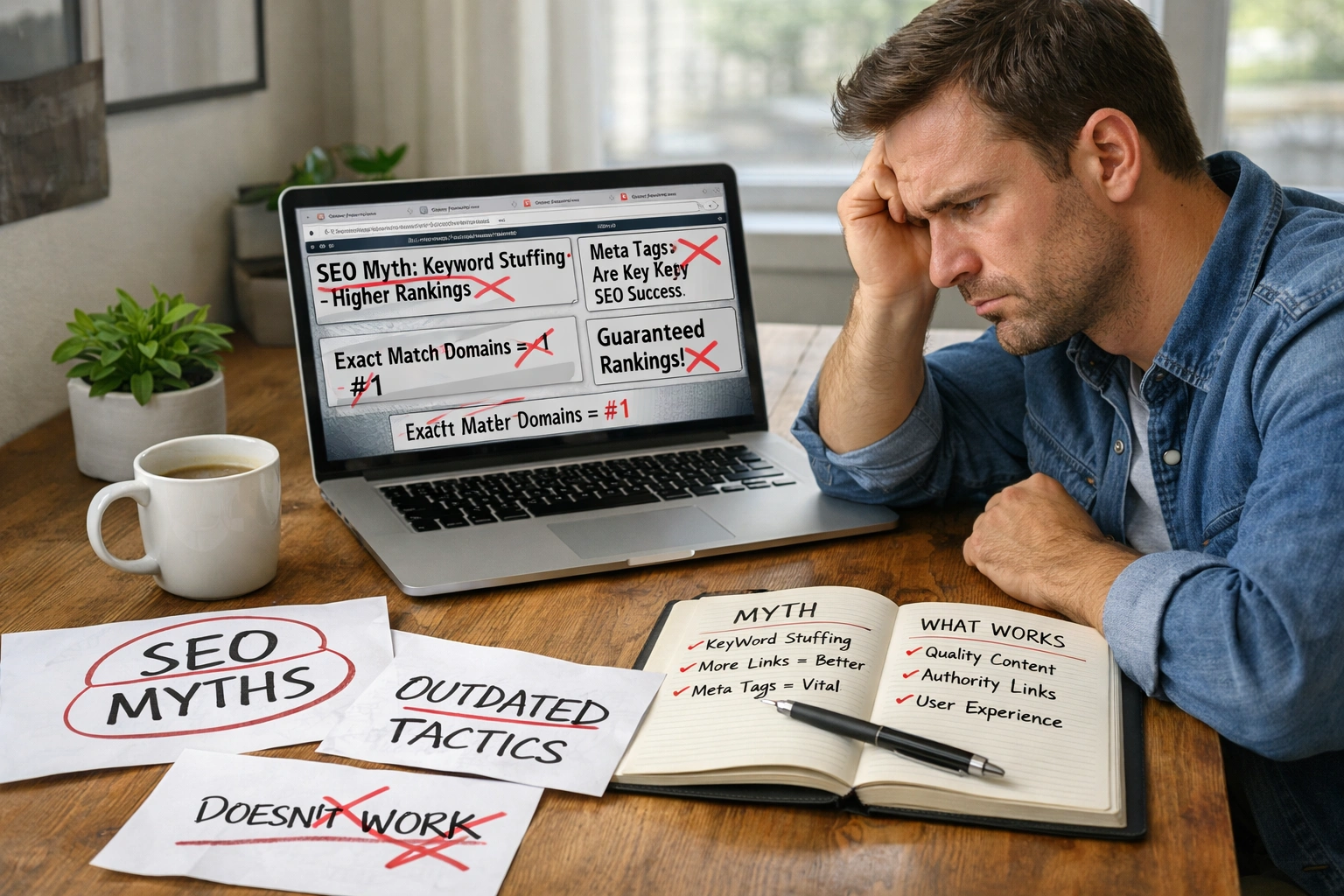
SEO Myths

The Misconceptions That Keep Businesses From Ranking Well

You’ve probably heard a thousand SEO myths floating around. Some of them sound convincing. Others seem like they came straight from 2010. But here’s the thing: following the wrong advice can drop your search engine rankings faster than you’d think.

We’ve seen some bad SEO myths waste people’s time, drain their budgets, and keep their websites buried where no one can find them. Meanwhile, their competitors are ranking higher because they know what truly works for their website.

This article breaks down the most common SEO myths that are hurting your business every day. So, you’ll learn:

  • Which tactics to drop immediately
  • What search engines actually care about
  • How to focus your seo efforts on strategies that deliver real results

Ready to stop guessing and start ranking?

SEO Myths That Sabotage Your Rankings
SEO Myths That Sabotage Your Rankings

Have you ever noticed your rankings drop after following some popular SEO advice? Well, it happens because some of the most repeated SEO myths actually hurt your search engine rankings instead of helping them.

Let’s have a look at a few such SEO myths:

Keyword Stuffing Still Works

When you walk into any digital marketing discussion, someone will likely tell you to stuff your keywords everywhere.

You might also be inclined to believe more keywords equal better rankings, right? Wrong.

Believe it or not, keyword stuffing triggers penalties from search engines faster than almost any other tactic. When you overload pages with the same keywords over and over, Google’s algorithms spot it immediately. Plus, your content gets harder to read, users bounce more often, and your SEO performance drops.

Because modern ranking algorithms prioritise one thing: relevant content that aligns with user intent. So, if you’re repeating “Brisbane SEO services” fifteen times in 300 words, you’re doing it wrong. You should instead focus on natural language and write for people first (not for robots).

Meta Descriptions Have No Impact on Clicks

Some people claim meta descriptions don’t have much impact anymore. They also say, “Google rewrites them anyway, so why bother?”

While that’s half true, it’s completely misleading. Let’s learn why.

Meta descriptions don’t directly increase your rankings. But they surely affect your click-through rates from search results. Because a well-written meta description always sets clear expectations. It also tells searchers exactly what they’ll find on your page.

Beyond that, title tags and meta tags work together to attract qualified traffic. So, if yours are generic or missing, Google will pull random text from your page. But those random auto-generated snippets rarely perform like your written and optimized ones.

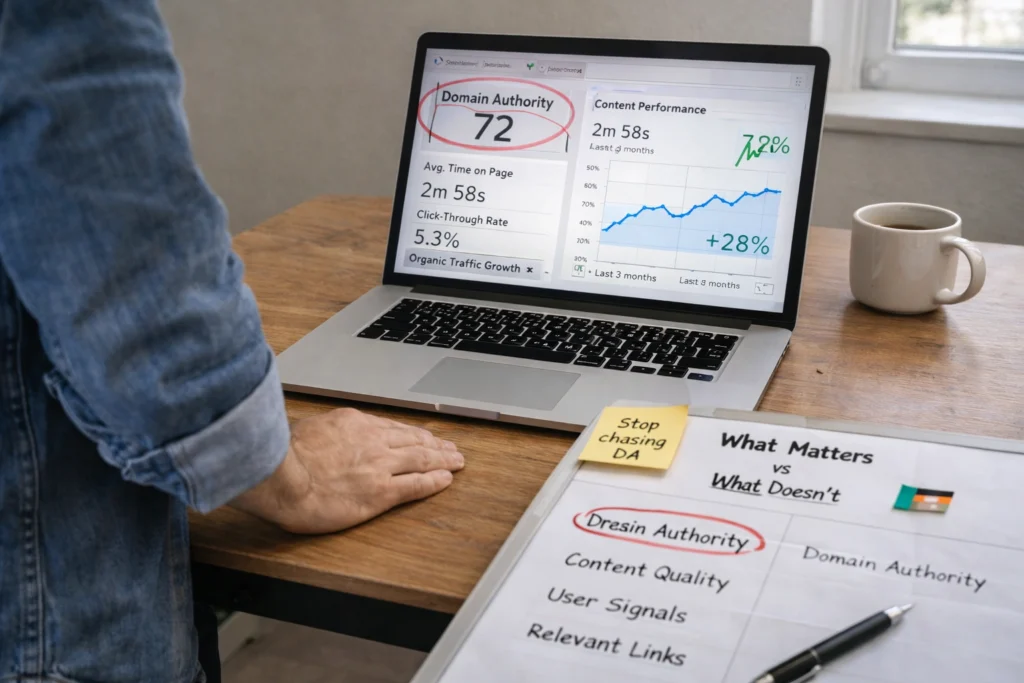
Domain Authority Is Everything

Domain authority scores cause more stress than they should (and yes, we’ve all obsessed over that number at some point).

But the truth is that domain authority is a third-party metric created by SEO tools. It’s not part of Google’s ranking algorithm. Google doesn’t look at it in the primary stages (Webmaster Trends Analyst at Google, John Mueller, jokingly dismissed this idea in a Reddit AMA.)

Sometimes, new websites can totally outrank established ones with better content, stronger user signals, and more relevant links from other websites. Here, high-quality content carries more weight than your domain’s age.

Quick tip: Focus your energy on earning natural backlinks and creating genuinely helpful pages instead of chasing arbitrary DA numbers.

Common SEO Misconceptions About Content

Common SEO Misconceptions About Content

Content-related common SEO misconceptions cost your businesses thousands in wasted effort every year. So, let’s clear up three big ones first.

Duplicate Content Gets You Penalised

Google doesn’t penalise duplicate content the way most people think. Instead, search engines filter duplicates and show the version they find most relevant. This way, one page ranks while others sit invisible.

However, internal duplication confuses Google’s algorithms about which page deserve most significance. That’s why we recommend using canonical tags to tell search engines which version to prioritise.

No Content Is Better Than Low-Quality Content

When you publish rushed and thin content, it damages your site faster than leaving sections blank. Plus, low-quality content increases bounce rates by destroying your user engagement. It also tells Google your site doesn’t deserve high rankings.

And that’s where things get scary. Google’s helpful content system now actively demotes websites that publish unhelpful pages regularly.

Our tests with client sites revealed that one well-researched article brings more website traffic than ten rushed posts with minimal value. It proves that content quality beats quantity every time.

Content Marketing Equals Blog Posts Only

Content marketing includes videos, infographics, podcasts, and case studies beyond blogs. These different formats reach your target audiences at different stages of the conversion funnel. Where someone researching might watch a YouTube video. Others are ready to buy and want a detailed comparison.

Verdict: Diversifying content types improves engagement across multiple digital marketing channels.

Technical Myths: Core Web Vitals and Local SEO

What if you fix your site speed perfectly, but it still doesn’t move you up in rankings? Well, technical SEO myths cause the most confusion here because they sound so official.

Here’s what is truly needed beyond those myths:

Technical Myth

The Reality

Perfect core web vitals guarantee high rankings

Page experience is significant, but Google’s algorithms weigh many factors beyond page speed alone

Local SEO just needs a Google Business listing

You need consistent NAP information (Name, Address, Phone number), genuine reviews, location pages, and a mobile-friendly design across your site

Technical fixes show immediate results in search

Improved site speed and optimised structure increase conversion rates first, then ranking improvements follow over time

Mobile-first indexing is optional

Google uses mobile versions for all websites now. Screen readers and accessibility affect user behaviour signals, too

Through our practical work with Brisbane businesses, we’ve seen such technical improvements drive better user engagement before rankings change. So, when your site loads fast and works smoothly, visitors stay longer.

Plus, that data eventually tells search engines your page experience deserves higher search visibility.

The Reality Behind Immediate Results and Keyword Research

The Reality Behind Immediate Results and Keyword Research

Proper keyword research and realistic expectations save you from wasting months on tactics that never deliver customers. So what’s the real deal here? Well, SEO takes ongoing effort rather than a one-off fix.

So, let’s learn the elements that can keep your SEO performance constant and better:

  1. Timeline For Results: SEO typically takes 3-6 months to show measurable ranking improvements (spoiler: there’s no magic overnight switch). Because Google needs time for indexing and authority building across your site.
  2. Conversion Rates Depend on More Than Traffic: Landing page quality, clear value propositions, and trust signals are important just as much as getting visitors. It means a technically correct page with poor messaging won’t convert visitors in customer.
  3. Quick Wins Exist Through Low-Hanging Fruit: Fixing broken links, optimizing existing title tags, and improving page structure can show impact within weeks. These don’t require waiting months.
  4. Paid Ads Deliver Immediate Results: While SEO builds long-term search visibility, ads bring customers immediately. Here, data from Google Analytics guides both strategies.
  5. Keyword Research Balances Multiple Factors: Search volume carries less weight than user intent and fits with what your business offers. Meanwhile, long-tail keywords often convert better than broad search terms despite lower traffic numbers.
  6. Search Intent Reveals Customer Readiness: Most times, knowing user intent makes keyword targeting more accurate. It also brings in customers who are ready to act.
  7. Focus on Key Topics, Not Individual Keywords: Modern search algorithms understand related concepts. That means if your content is well structured and covers a topic in depth, it can rank for hundreds of relevant terms.

Bottom line: Set realistic expectations, and use tools like Google Analytics to track actual conversion data. Then focus your process on creating relevant information that matches what your target audience truly searches for. These are the keys behind immediate results.

Stop Chasing Rankings, Start Building Results

SEO myths hold businesses back from real growth. Because the strategies that worked five years ago don’t work now. So, the tactics everyone recommends might be exactly what’s hurting your rankings.

Focus on what search engines truly reward: high-quality content that serves users, technically sound websites, and keyword research based on user intent. This way, when you stop chasing shortcuts and start building value, the ranking improvements follow naturally.

Want to learn more about SEO strategies that actually work? With more than a decade of experience, the AccuvantLabs blog covers search engine optimization topics in a practical, hands-on way.

Check out our latest articles today and discover how proper SEO can convert your business’s visibility.

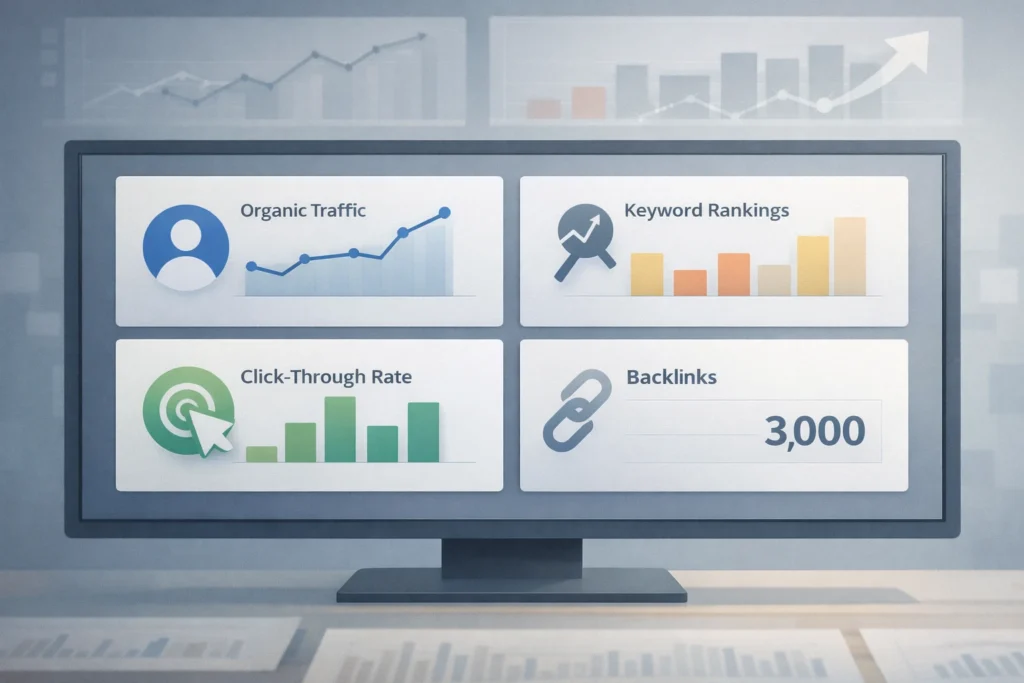
SEO metrics

The Simple Metric Most Businesses Ignore in SEO

If you check any SEO dashboard, you’ll find businesses focusing heavily on keyword rankings, organic traffic, and backlink counts. These are the SEO metrics most companies track consistently.

But they only scratch the surface of what’s actually happening on your site. Sure, organic traffic tells you how many people showed up. Keyword rankings show where you appear in Google search. And backlinks? They measure your site’s authority.

The bigger opportunity sits in overlooked digital marketing metrics like engagement depth and scroll rate. These reveal whether visitors care about your content or leave after a few seconds.

In this article, we’ll cover the simple metrics most businesses ignore and how they reveal what traffic numbers alone can’t.

The SEO Metrics Most Businesses Track

The SEO Metrics Most Businesses Track

Most businesses track organic traffic, keyword rankings, and click-through rates because they’re easy to find in Google Search Console and give a quick snapshot of SEO performance.

Take organic search traffic, for example. You might have seen 5,000 page views last month, but did visitors read the content or click around? Or did they bounce after glancing at the first paragraph? Search Console doesn’t tell you that part.

Rankings work the same way. They show you search visibility, but can’t measure whether the content connects with your target audience. Ranking #3 for “Brisbane SEO services” looks great on paper. But if visitors leave within seconds, that ranking isn’t doing much for your business.

Similarly, click-through rates demonstrate title appeal yet provide no insight into actual user engagement or content quality. In other words, you’re only seeing the tip of the iceberg.

Engagement Depth: How Long People Stay (and Why It Counts)

Engagement depth measures how much of your content visitors actually consume. Unlike the total time on page, it shows whether users are truly reading and interacting, or just skimming before leaving.

The difference becomes clear when compared with older engagement metrics like bounce rate.

How It’s Different from Bounce Rate

Bounce rate tracks the percentage of visitors who leave without clicking elsewhere on your site. It’s been the standard SEO metric for years, but it misses a lot.

Think about it. A visitor can leave your page quickly but still read the full article or scroll through multiple sections. Engagement depth captures that behaviour. It shows the real quality and relevance of your content, while bounce rate on its own often paints an incomplete picture.

What Good Engagement Looks Like on Your Site

Strong engagement usually means visitors scroll past most of your content and spend time across multiple sections. They click internal links, watch embedded videos, or complete forms and download resources.

When engagement depth is high, businesses often see higher conversion rates, longer sessions, and lower cost per acquisition. These visitors read the content, explore your pages, and take meaningful actions.

Scroll Rate: Are Visitors Reading Your Content?

Scroll Rate: Are Visitors Reading Your Content?

Yes, most visitors do scroll, but not as far as you might expect. According to Chartbeat, 55% of people spend fewer than 15 seconds actively engaged with a page. That gives you a very short window to capture their attention before readers move on.

This is where scroll rate becomes useful. It tracks how far down the page visitors move, which helps show whether your content holds their interest. If most readers drop off after the first two paragraphs, something isn’t working. It could be a weak opening, poor formatting, or content that doesn’t match what they searched for.

On the flip side, high scroll rates suggest visitors find value throughout the page. They’re reading multiple sections and spending time with the content. That kind of user behaviour aligns with what search engines associate with useful, relevant content.

Relevance Match in Google Search Console

Relevance match tells you if visitors find what they expected when they clicked your link from search results. For instance, if someone searches for “best coffee in Brisbane” but lands on your page about coffee bean suppliers, they’ll likely bounce straight back to Google search.

Here’s what relevance match reveals about your content performance:

  • Strong Relevance Match: When your content aligns with search intent, people stick around. They read more, click internal links, and engage with your site. This reduces immediate exits and improves your overall user engagement metrics (which is exactly what you want).
  • Poor Relevance Match: Visitors realise the page doesn’t answer their question and leave quickly. Frequent early exits signal to Google that your content may not be meeting user needs.
  • Tracking Through Search Console: Watch your average time on page and pages per session in Google Search Console. If people land and immediately leave, your relevance match needs work. The content might be solid, but it’s not matching what people actually want when they click your link.

The key is making sure your title, meta description, and actual content all deliver on the same promise.

Time to First Interaction: Why Response Time Beats Page Speed

Time to First Interaction: Why Response Time Beats Page Speed

You click a button and… nothing. The page loaded fine, but now it’s frozen for three seconds while scripts catch up.

Time to first interaction measures how quickly visitors can click buttons, fill out forms, or navigate your site without delay. The page looks ready, but the buttons won’t respond because JavaScript is still loading in the background. Even when a page loads quickly, this lag frustrates users who just want to take action.

This is different from Core Web Vitals, which focuses on loading speed and visual stability. The time between the first interaction shows whether site visitors can use your page once it appears.

Improving interaction time reduces friction and increases customer engagement. When people can interact immediately, they’re more likely to stay and convert. Slow interaction, on the other hand, sends them straight to your competitors.

How These Metrics Shape Your Digital Marketing Strategy

Once you start tracking these metrics, you’ll spot patterns that change how you spend on digital marketing.

For example, blog posts might drive tons of organic traffic but show low engagement depth. Meanwhile, your how-to guides might get less traffic but keep people engaged for minutes at a time. That tells you where to focus your content creation efforts.

Other metrics like scroll rate and relevance match show you exactly what needs fixing to increase conversions without spending more on Google Ads or paid advertising. If visitors bounce after two paragraphs, you don’t need more traffic. You need better content that matches search intent.

These engagement metrics reveal which digital channels actually deliver results. Instead of throwing money at more ads across social media platforms or email marketing, you can improve what’s already working and cut what isn’t.

Tools That Track Customer Engagement

Tools That Track Customer Engagement

You probably already have access to tools that track these metrics, but most businesses never turn them on. Setting them up takes minutes and can reveal exactly where your content loses people.

Here are the best tools for tracking customer engagement:

  • Google Analytics 4: Most analytics platforms include engagement tracking, but businesses rarely activate it or explore beyond the basics. GA4 can track scroll depth, but you need to configure custom events to capture meaningful data (though most businesses skip this step entirely). The functionality is already in your dashboard, waiting to be set up.
  • Heatmap Tools: Tools like Hotjar reveal exactly where visitors click, scroll, and abandon your content throughout the page. You can see which sections get read and which get skipped. This visual data makes it easy to spot problems that raw numbers might miss.
  • Google Search Console: Beyond basic traffic reports, Search Console shows you which search queries bring engaged users to your site. You can track average engagement time per query and see which landing pages keep people around longest. These insights help you double down on content that works.
  • Microsoft Clarity: If you want to understand why engagement drops, not just where, Clarity makes that visible. It records real user sessions so you can see where visitors hesitate, click repeatedly, or abandon a page. This helps you identify friction points that don’t show up in traffic or engagement reports alone.

The good news is you don’t need all of these at once. Start with one or two SEO tools and expand from there as you get comfortable with the data.

Start With One Metric This Week

You don’t need to become a data scientist overnight. Pick one overlooked SEO metric like scroll rate or engagement depth and monitor it for 30 days. See what patterns emerge.

That’s where most businesses go wrong: chasing keyword rankings without paying attention to visitor behaviour. Small changes based on real visitor behaviour often beat obsessing over rankings. You might discover your intro loses people, your formatting needs work, or your titles overpromise what the content delivers.

Start tracking what happens after people land on your site, not just how many showed up. And if you need help making sense of the data, we’re here to help.

SEO Research

Why Strong SEO Starts With Good Research, Not Keywords

Most businesses start their SEO plan by simply chasing keywords with high search volumes. They pick a few high-traffic terms, write content around them, and hope Google does the rest.

The problem is that keyword research on its own doesn’t explain why people search or what Google actually wants to rank. Without that context, even well-written pages struggle to perform.

Strong SEO research starts by looking at what already works. That means analysing competitors, studying page-one results, and understanding the intent behind each search. When you do that, keywords stop being guesses and start becoming a strategy.

This article walks you through the research side of SEO that most people skip. You’ll see how competitor analysis, SERP mapping, and user intent give you a clearer plan than keywords ever could on their own.

SEO Research vs Keyword Research: What’s the Difference?

SEO Research vs Keyword Research: What's the Difference?

SEO research digs into search behaviour and competitor strategies, while keyword research just finds search terms.

You might be thinking, “Wait, aren’t they the same thing?” Well, not quite. Keyword research shows you what people type into a search engine and how often they search for it. While that’s useful, it’s only part of the picture.

SEO research goes deeper. It looks at competitor weaknesses, SERP features like featured snippets or local packs, and which content formats Google ranks at the top for your keywords. Basically, you’re studying the whole search environment around your topic, not just chasing high search volume terms.

For example, a Brisbane physio clinic might find that “lower back pain exercises” has great search volume, but the top results are likely all video tutorials, not blog posts. So it’s better to create video content instead of wasting time on a 2,000-word article that Google won’t rank.

How Competitor Analysis Uncovers Ranking Opportunities

Your competitors have already spent time and money figuring out what works. There’s no reason not to learn from their wins and losses (saves you months of trial and error). Here’s how competitor analysis helps you identify gaps your competitors miss:

Finding Your SEO Competitors

Your SEO competitors aren’t always your business competitors. They’re the sites that rank for your target keywords, even if they don’t sell the same products or services.

For instance, a Brisbane cafe’s SEO competitor could be a Melbourne food blog ranking for “best coffee beans in Australia.” The blog isn’t competing for local customers, but it’s competing for the same search visibility.

To identify your SEO competitors, run your focus keyword in Google and note which domains consistently appear in positions one through ten. These are the sites you need to study.

What Ranking Sites Reveal About Search Intent

What Ranking Sites Reveal About Search Intent

Once you know who’s ranking, the next step is figuring out why Google ranks them.

Start by checking if the top results are comparison posts, how-to guides, or product pages. This tells you what searchers expect when they type in that keyword.

Beyond the content type, pay attention to heading structures and topics covered. If every top result includes a pricing section or customer reviews, that’s Google telling you those elements help you rank for that particular search.

SERP Mapping: Identifying Google’s Priorities Before You Write

Some keywords need detailed guides while others want quick listicles, and Google’s first page tells you exactly which one. SERP features like featured snippets, People Also Ask boxes, and local packs show what Google thinks searchers need when they type in that keyword.

If image carousels or video results dominate the SERP, text-only content will struggle no matter how good your keyword optimisation is. Google’s already decided that searchers want visual content for that search, so a 2,000-word blog post won’t rank well.

After you’ve checked the features, you should study the word counts, media types, and content angles of the top five results. When your content format hits the mark with what’s already ranking, you’re halfway there.

Take “Brisbane wedding venues” as an example. If the top results all include photo galleries and pricing tables, your page needs those elements to compete.

Why User Intent Outweighs Keyword Difficulty

You could rank number one for a 10,000 search keyword and still get zero customers if the intent’s off. That’s exactly what happens when most people chase the easy keywords and wonder why nothing converts.

Here are three reasons why intent should guide your keyword choices:

  • Wrong Intent Kills Conversions: A keyword with lower difficulty might look tempting, but if searchers want free guides and you’re selling services, you won’t convert visitors. You’re attracting the wrong crowd.
  • Matching Intent Solves the Right Problem: When your content answers the specific question or solves the problem the searcher has right now, they stick around. That’s when you turn search traffic into potential customers.
  • Google Rewards Relevance Over Authority: Google prioritises relevance over domain authority (even the big players with years of backlinks). Nailing intent helps smaller sites outrank established competitors. A South Brisbane marketing agency can beat a global firm if its content better matches what searchers need.

Getting the right keywords means nothing if you’re answering the wrong questions.

Keyword Analysis Tools That Support Better Research

Keyword Analysis Tools That Support Better Research

Back in 2010, keyword research meant manually tracking spreadsheets for hours, but nowadays, tools do the heavy lifting in minutes. The best keyword research tools give you data on search volume, keyword difficulty, and related keywords all in one place.

Let’s look at some of the most popular keyword research tools and what they offer:

ToolBest For Key Features 
Google Keyword Planner Free keyword ideasSearch volume data, keyword suggestions, works with Google Ads account 
Semrush Keyword Research Comprehensive keyword analysis  Keyword difficulty scores, SERP features, competitor keywords 
Ahrefs Keywords Explorer Backlink and keyword research Keyword tool with search volume, related keywords, content gap analysis 

Google Keyword Planner is the go-to free tool for most people starting out. You’ll need a Google Ads account to access it, but you don’t need to run any ads. It shows search volume estimates and helps you discover new keyword ideas based on your site or industry.

If you want more detail, tools like Semrush Keyword Research or Ahrefs Keywords Explorer go further than free options. These paid keyword research tools provide keyword difficulty scores and SERP feature data together, so you can see which keywords are worth targeting before you create content.

That said, free tools still cover the basics with monthly search volume. Paid platforms, on the other hand, reveal seasonality trends and question-based keyword variations. If you’re serious about SEO, investing in one of these SEO tools saves you time and helps you find keyword opportunities your competitors miss.

Building an SEO Strategy From Research Up

Building an SEO Strategy From Research Up

Research hands you a clear roadmap so you’re not wasting budget on topics that’ll never convert. To build that roadmap, start with keyword research to identify content gaps in your site, then prioritise topics based on search volume and competition levels. This tells you exactly which pages to build first.

After you learn what to create, your SEO strategy should map keywords to specific pages while considering user intent at each stage of the search journey. Someone searching “what is SEO” needs educational content, while “SEO services Brisbane” means they’re ready to buy. Each keyword gets its own URL and purpose.

From there, your research informs your content calendar, internal linking structure, and which pages deserve the most optimisation effort. You can refine your plan as you go, but the initial research gives you a foundation that keeps your business focused on keywords that drive results.

Research First, Rankings Follow

Keyword research gets you started, but proper SEO research gets you results. When you understand what Google ranks, why it ranks those pages, and what searchers actually need, your content plan becomes sharper and more focused.

You’ve now seen how competitor analysis reveals gaps, how SERP mapping shows Google’s preferences, and why user intent beats keyword difficulty every time. Good research is worth its weight in gold when you’re deciding where to invest your time and budget.

If you need help building an SEO strategy backed by solid research, get in touch with us. We’ll help you figure out what’s working for your competitors.