Search intent drives content performance by telling Google whether your page actually answers what the searcher needed. When your content matches that intent, Google rewards it with better rankings, longer time on page, and organic traffic that converts.
The problem is that most SEO content starts with a keyword and stops there. The intent behind that keyword (why someone is actually searching it) gets overlooked. And that gap is usually why a well-optimised page loses clicks to one that better matches what users are looking for.
This article explains search intent in SEO, including how to identify it during keyword research. It also covers ways to align your content strategy so your pages rank for the right audience and actually convert.
But first, let’s get clear on what search intent means in SEO.
What Search Intent Means in SEO
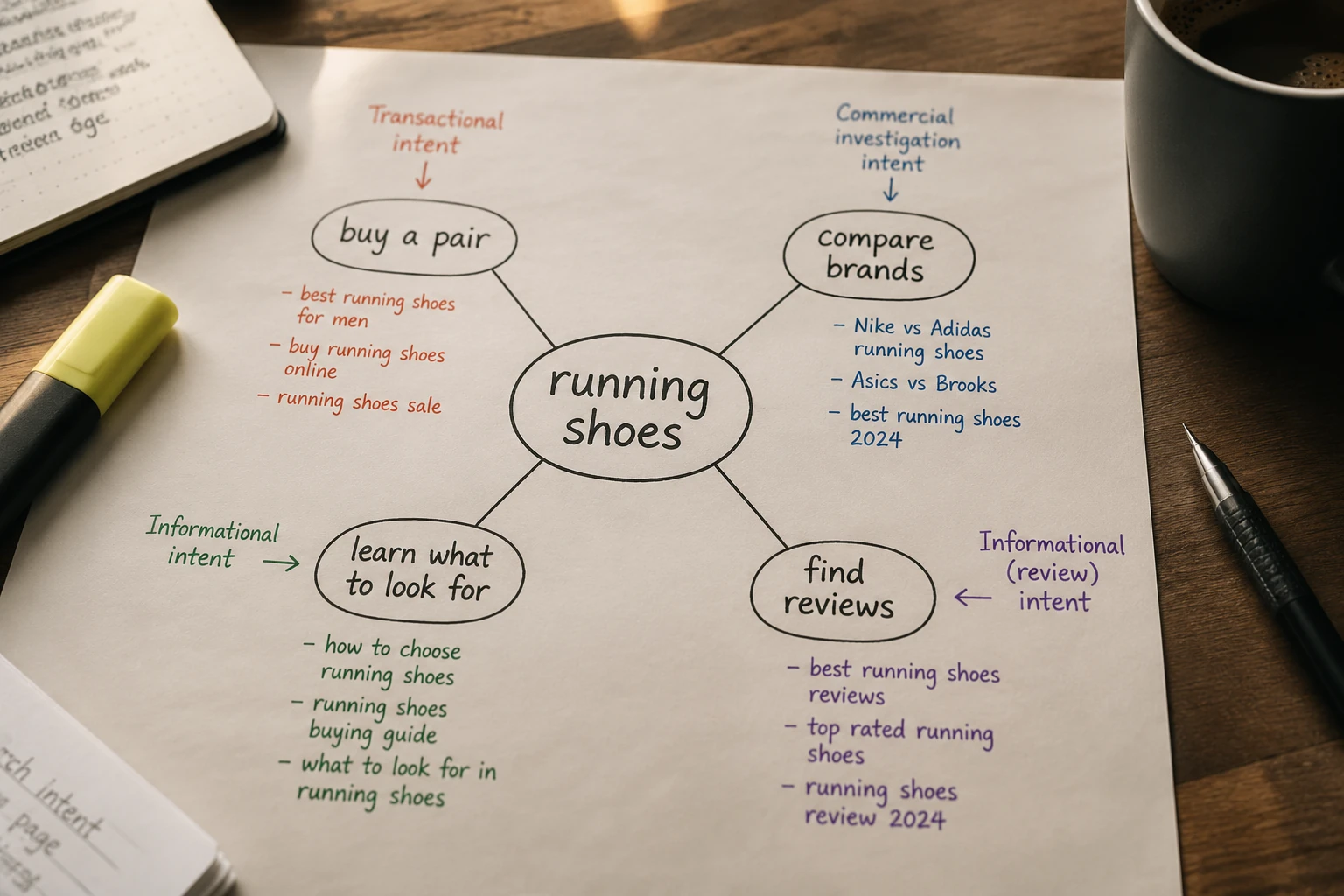
Search intent, also called user intent, is the goal behind a search query. It’s not the keyword itself but the reason someone typed it into Google. Someone searching “running shoes” might want to buy a pair, compare brands, or simply learn what to look for. The keyword is the same, but the reason behind the search is completely different.
Search engines use that goal to decide which pages deserve to rank. Rather than matching keywords alone, Google looks at the type of content that consistently satisfies people searching for a query. It then prioritises pages that best match what searchers are trying to accomplish.
The Four Types of Search Intent
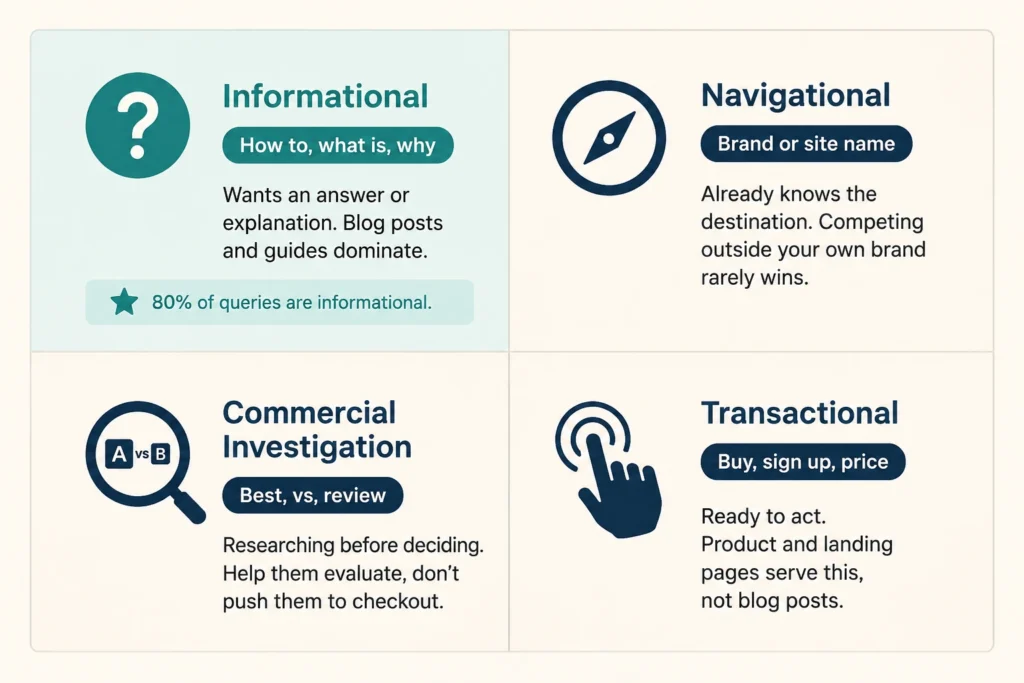
Every search query falls into one of four intent categories: informational, navigational, commercial investigation, and transactional. The sections below break down each one.
Informational
Informational intent covers searches where someone wants a clear answer, an explanation, or a guide. Blog posts and long-form content tend to dominate search results for these queries because the searcher wants depth rather than a sales pitch.
It’s also one of the most competitive intent types, due to its sheer volume. In fact, more than 80% of web queries are informational. That means almost every SEO content strategy is competing for the same pool of searches.
Navigational
For most businesses, this is the narrowest opportunity of the four. The searcher already has a destination in mind. They’re usually typing in a brand name or a specific website to get there faster. Competing for these queries outside your own brand almost never leads to meaningful rankings or traffic.
Commercial Investigation
At this point in the search journey, the searcher hasn’t made a decision yet. They’re researching options, comparing products, or reading reviews before committing (easily the most misread intent type). That’s why content here should help them evaluate their choices rather than push them toward a checkout.
Transactional
Searchers with transactional intent have already decided to act. Examples include typing in “buy Nike Air Max online” or “sign up for SEMrush free trial.” They know what they want and just need the right page to land on. Product pages and landing pages serve this intent best, and blog content targeting these keywords rarely converts even when it ranks.
Why Google Prioritises Search Intent Over Keywords
For a long time, ranking on Google was largely about keywords. You found the right ones through keyword research, placed them in strategic locations, and waited for organic search traffic to follow. That approach worked when search engines relied much more heavily on matching the words in a query to the words on a page.
Today, Google looks far beyond individual keywords. It analyses context, language, and the overall meaning of a query to understand what the searcher is trying to accomplish. That’s why a search like “why isn’t my content ranking” can return highly relevant results even though there’s no single keyword to match.
Content can target a relevant keyword and still struggle to rank for the same reason. If the page doesn’t satisfy the intent behind the search, Google is more likely to favour competing content that does. To rank consistently, you need to understand why someone searched in the first place and create content that satisfies that need.
How to Identify Search Intent During Keyword Research
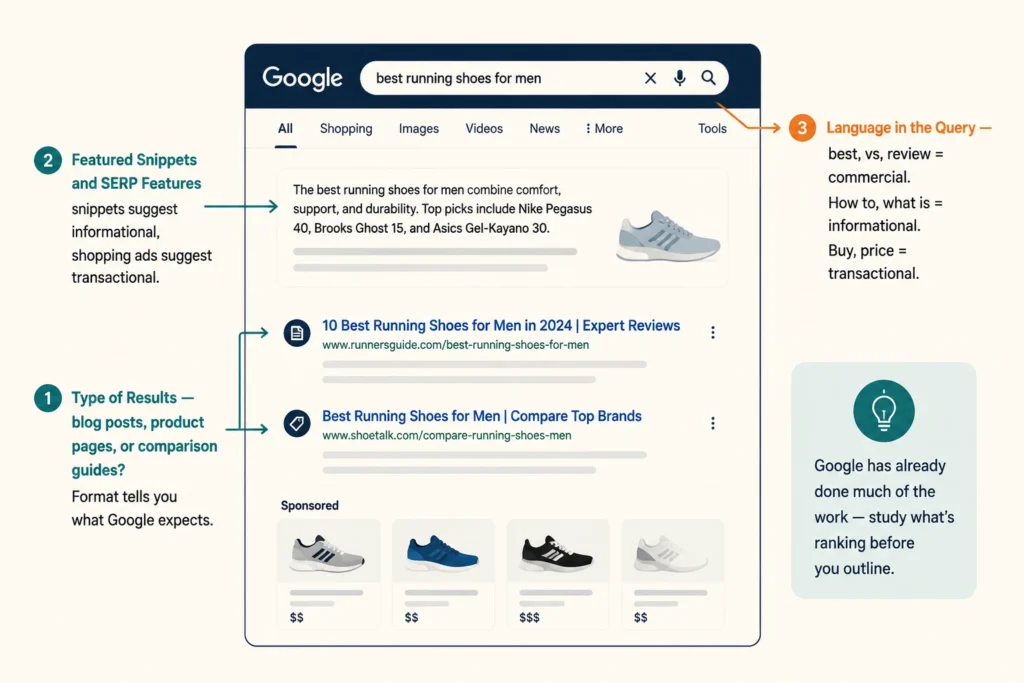
The fastest way to identify search intent is to study what’s already ranking, since Google has effectively done much of the work for you. Before building an outline, search your target keyword and look for patterns in the first page of results.
Three signals will usually tell you what type of content Google expects.
- Type of Results: Look at what’s ranking on the first page of search engine results. Are they blog posts, product pages, landing pages, or comparison guides? The format Google consistently rewards tells you what type of content it expects for that query.
- Featured Snippets and SERP Features: SERP features can reveal intent at a glance. Featured snippets often indicate informational searches, shopping ads suggest transactional intent, and comparison-heavy results usually point to commercial investigation. Together, they give you a clearer picture of what the searcher actually needs.
- Language in the Query: The words in the search itself are a signal. Terms like “best,” “vs,” or “review” point to commercial intent, while “how to,” “what is,” or “why” indicate informational intent. “Buy” or “price,” meanwhile, are transactional flags.
We’ve seen pages with solid research, strong writing, and proper optimisation underperform simply because they targeted the wrong intent. A quick SERP review before outlining is often enough to prevent that.
Matching Your Content Strategy to Search Intent
Once you know the intent behind a keyword, the format, tone, and depth of your content should follow directly. The table below shows how each intent type typically maps to a content decision.
| Intent Type | Content Format | Primary Goal | CTA |
| Informational | Guides, blog posts, tutorials | Answer the question clearly | Link to related resources |
| Navigational | Brand or landing pages | Help users reach the right destination | Direct them to the relevant page |
| Commercial Investigation | Comparison guides, reviews, case studies | Help users evaluate options | Learn more, request a demo, book a consultation |
| Transactional | Product or service pages | Make taking action easy | Buy, sign up, request a quote |
Use intent to decide the purpose of a page before you decide how to write it. Trying to serve multiple intents with the same content usually leads to a weaker result.
Auditing Existing Content for Intent Mismatch
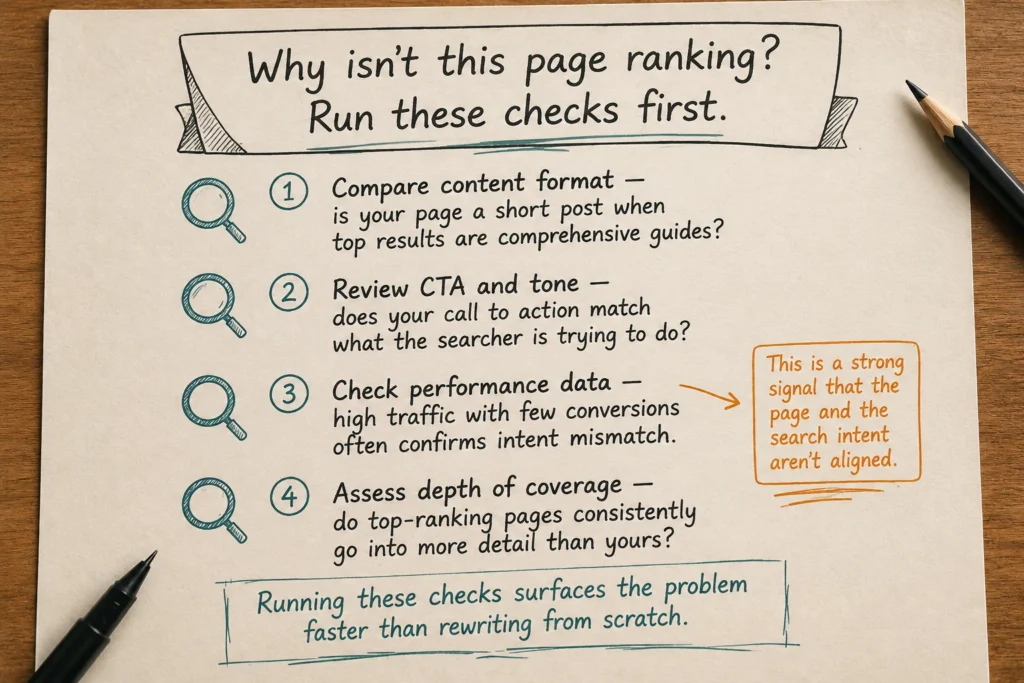
If a page isn’t ranking despite solid keyword targeting, the intent might be off rather than the writing itself. To find out, run through these checks:
- Compare the Content Format: If your page is a product page or short blog post but most of the top results are comprehensive guides, the format itself may be the mismatch. That means your content type doesn’t align with what searchers expect.
- Review the CTA and Tone: Your call to action should match what the searcher is trying to do. An informational query usually needs educational CTAs, while a buyer-focused query should guide users toward a purchase or enquiry.
- Use Performance Data as Confirmation: Metrics like impressions, click-through rate, and time on page can reinforce what your audit already suggests. They don’t prove intent mismatch on their own, but patterns like high traffic with few conversions often confirm the page isn’t meeting searcher expectations.
- Check the Depth of Coverage: You can check how completely a page answers a searcher’s question by reviewing the content already ranking on page one. If those pages consistently go into greater detail than yours, your content may not be satisfying the intent fully.
Running through these checks on your lowest-performing pages will usually surface the problem faster than rewriting the content from scratch. Once the intent is right, decisions about format, depth, and tone tend to follow naturally.
Search Intent Is the Foundation of Better SEO
Search intent is where content strategy actually begins. Every decision that follows should trace back to what the searcher needed when they typed that query.
When that foundation is perfect, the results tend to follow. Over time, content that’s aligned with search intent is more likely to earn stronger rankings, keep visitors engaged, and convert the right audience.
If you’d like help building a content strategy around search intent, get in touch with the AccuVantLabs team. We work with businesses across Brisbane and beyond to create SEO content that earns visibility, attracts qualified traffic, and supports long-term business growth.
Frequently Asked Questions
These are some of the most common questions businesses have about search intent.
What role does content marketing play in search intent?
Content marketing works best when each piece is built around a specific intent. Publishing content without matching it to what your audience is actively searching for often results in traffic that doesn’t engage or convert.
How does search intent influence a content marketing strategy?
Search intent should inform which topics you prioritise, what format each piece takes, and where it sits in the buyer journey. It helps you create content that matches what your audience needs at each stage, rather than choosing topics based on search volume alone.
How does search intent affect content creation?
It determines everything before you write a single word. The format, depth, angle, and call to action all change depending on whether the searcher wants to learn, compare, or buy.