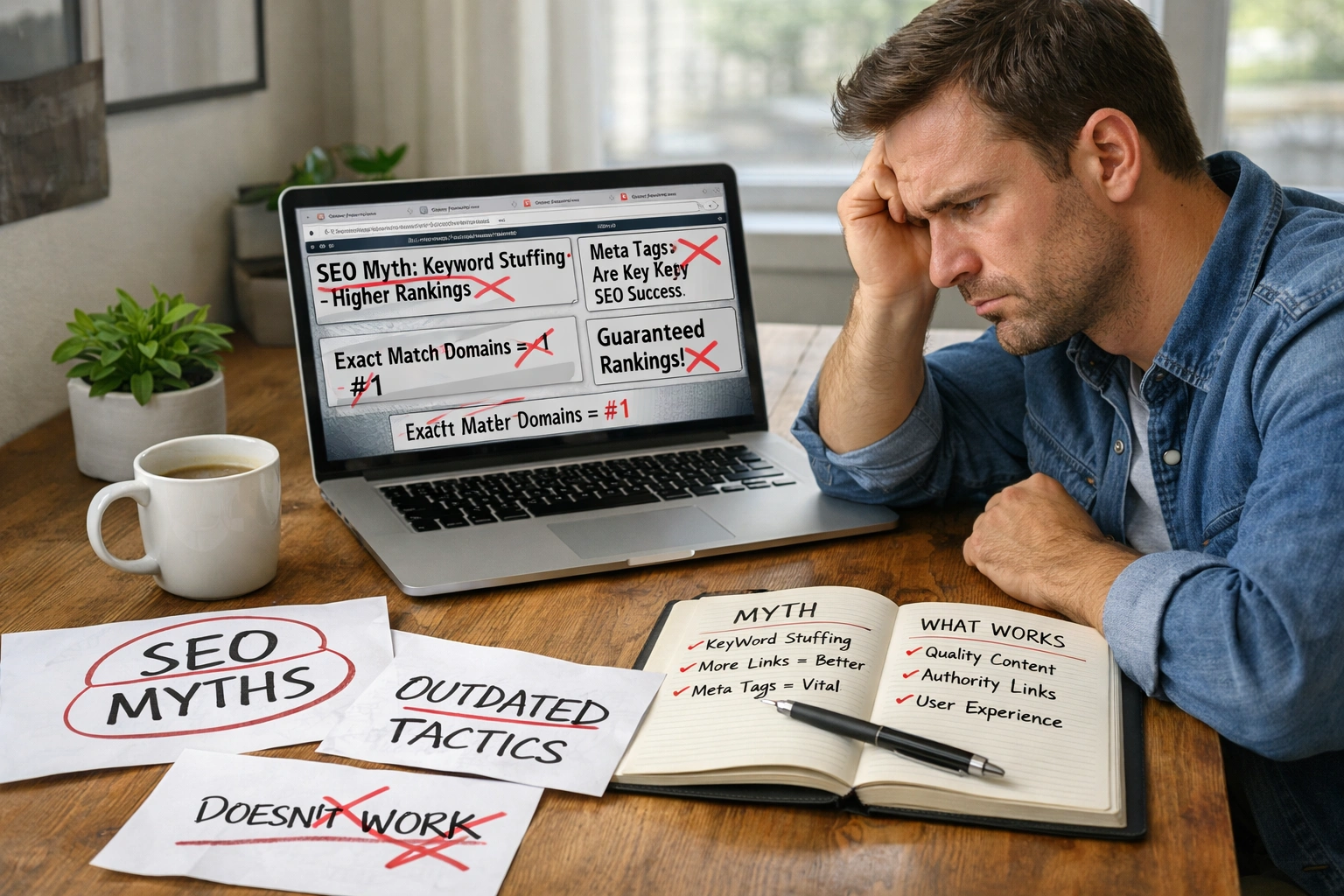
You’ve probably heard a thousand SEO myths floating around. Some of them sound convincing. Others seem like they came straight from 2010. But here’s the thing: following the wrong advice can drop your search engine rankings faster than you’d think.
We’ve seen some bad SEO myths waste people’s time, drain their budgets, and keep their websites buried where no one can find them. Meanwhile, their competitors are ranking higher because they know what truly works for their website.
This article breaks down the most common SEO myths that are hurting your business every day. So, you’ll learn:
- Which tactics to drop immediately
- What search engines actually care about
- How to focus your seo efforts on strategies that deliver real results
Ready to stop guessing and start ranking?
SEO Myths That Sabotage Your Rankings

Have you ever noticed your rankings drop after following some popular SEO advice? Well, it happens because some of the most repeated SEO myths actually hurt your search engine rankings instead of helping them.
Let’s have a look at a few such SEO myths:
Keyword Stuffing Still Works
When you walk into any digital marketing discussion, someone will likely tell you to stuff your keywords everywhere.
You might also be inclined to believe more keywords equal better rankings, right? Wrong.
Believe it or not, keyword stuffing triggers penalties from search engines faster than almost any other tactic. When you overload pages with the same keywords over and over, Google’s algorithms spot it immediately. Plus, your content gets harder to read, users bounce more often, and your SEO performance drops.
Because modern ranking algorithms prioritise one thing: relevant content that aligns with user intent. So, if you’re repeating “Brisbane SEO services” fifteen times in 300 words, you’re doing it wrong. You should instead focus on natural language and write for people first (not for robots).
Meta Descriptions Have No Impact on Clicks
Some people claim meta descriptions don’t have much impact anymore. They also say, “Google rewrites them anyway, so why bother?”
While that’s half true, it’s completely misleading. Let’s learn why.
Meta descriptions don’t directly increase your rankings. But they surely affect your click-through rates from search results. Because a well-written meta description always sets clear expectations. It also tells searchers exactly what they’ll find on your page.
Beyond that, title tags and meta tags work together to attract qualified traffic. So, if yours are generic or missing, Google will pull random text from your page. But those random auto-generated snippets rarely perform like your written and optimized ones.
Domain Authority Is Everything
Domain authority scores cause more stress than they should (and yes, we’ve all obsessed over that number at some point).
But the truth is that domain authority is a third-party metric created by SEO tools. It’s not part of Google’s ranking algorithm. Google doesn’t look at it in the primary stages (Webmaster Trends Analyst at Google, John Mueller, jokingly dismissed this idea in a Reddit AMA.)
Sometimes, new websites can totally outrank established ones with better content, stronger user signals, and more relevant links from other websites. Here, high-quality content carries more weight than your domain’s age.
Quick tip: Focus your energy on earning natural backlinks and creating genuinely helpful pages instead of chasing arbitrary DA numbers.
Common SEO Misconceptions About Content

Content-related common SEO misconceptions cost your businesses thousands in wasted effort every year. So, let’s clear up three big ones first.
Duplicate Content Gets You Penalised
Google doesn’t penalise duplicate content the way most people think. Instead, search engines filter duplicates and show the version they find most relevant. This way, one page ranks while others sit invisible.
However, internal duplication confuses Google’s algorithms about which page deserve most significance. That’s why we recommend using canonical tags to tell search engines which version to prioritise.
No Content Is Better Than Low-Quality Content
When you publish rushed and thin content, it damages your site faster than leaving sections blank. Plus, low-quality content increases bounce rates by destroying your user engagement. It also tells Google your site doesn’t deserve high rankings.
And that’s where things get scary. Google’s helpful content system now actively demotes websites that publish unhelpful pages regularly.
Our tests with client sites revealed that one well-researched article brings more website traffic than ten rushed posts with minimal value. It proves that content quality beats quantity every time.
Content Marketing Equals Blog Posts Only
Content marketing includes videos, infographics, podcasts, and case studies beyond blogs. These different formats reach your target audiences at different stages of the conversion funnel. Where someone researching might watch a YouTube video. Others are ready to buy and want a detailed comparison.
Verdict: Diversifying content types improves engagement across multiple digital marketing channels.
Technical Myths: Core Web Vitals and Local SEO
What if you fix your site speed perfectly, but it still doesn’t move you up in rankings? Well, technical SEO myths cause the most confusion here because they sound so official.
Here’s what is truly needed beyond those myths:
Technical Myth | The Reality |
Perfect core web vitals guarantee high rankings | Page experience is significant, but Google’s algorithms weigh many factors beyond page speed alone |
Local SEO just needs a Google Business listing | You need consistent NAP information (Name, Address, Phone number), genuine reviews, location pages, and a mobile-friendly design across your site |
Technical fixes show immediate results in search | Improved site speed and optimised structure increase conversion rates first, then ranking improvements follow over time |
Mobile-first indexing is optional | Google uses mobile versions for all websites now. Screen readers and accessibility affect user behaviour signals, too |
Through our practical work with Brisbane businesses, we’ve seen such technical improvements drive better user engagement before rankings change. So, when your site loads fast and works smoothly, visitors stay longer.
Plus, that data eventually tells search engines your page experience deserves higher search visibility.
The Reality Behind Immediate Results and Keyword Research

Proper keyword research and realistic expectations save you from wasting months on tactics that never deliver customers. So what’s the real deal here? Well, SEO takes ongoing effort rather than a one-off fix.
So, let’s learn the elements that can keep your SEO performance constant and better:
- Timeline For Results: SEO typically takes 3-6 months to show measurable ranking improvements (spoiler: there’s no magic overnight switch). Because Google needs time for indexing and authority building across your site.
- Conversion Rates Depend on More Than Traffic: Landing page quality, clear value propositions, and trust signals are important just as much as getting visitors. It means a technically correct page with poor messaging won’t convert visitors in customer.
- Quick Wins Exist Through Low-Hanging Fruit: Fixing broken links, optimizing existing title tags, and improving page structure can show impact within weeks. These don’t require waiting months.
- Paid Ads Deliver Immediate Results: While SEO builds long-term search visibility, ads bring customers immediately. Here, data from Google Analytics guides both strategies.
- Keyword Research Balances Multiple Factors: Search volume carries less weight than user intent and fits with what your business offers. Meanwhile, long-tail keywords often convert better than broad search terms despite lower traffic numbers.
- Search Intent Reveals Customer Readiness: Most times, knowing user intent makes keyword targeting more accurate. It also brings in customers who are ready to act.
- Focus on Key Topics, Not Individual Keywords: Modern search algorithms understand related concepts. That means if your content is well structured and covers a topic in depth, it can rank for hundreds of relevant terms.
Bottom line: Set realistic expectations, and use tools like Google Analytics to track actual conversion data. Then focus your process on creating relevant information that matches what your target audience truly searches for. These are the keys behind immediate results.
Stop Chasing Rankings, Start Building Results
SEO myths hold businesses back from real growth. Because the strategies that worked five years ago don’t work now. So, the tactics everyone recommends might be exactly what’s hurting your rankings.
Focus on what search engines truly reward: high-quality content that serves users, technically sound websites, and keyword research based on user intent. This way, when you stop chasing shortcuts and start building value, the ranking improvements follow naturally.
Want to learn more about SEO strategies that actually work? With more than a decade of experience, the AccuvantLabs blog covers search engine optimization topics in a practical, hands-on way.
Check out our latest articles today and discover how proper SEO can convert your business’s visibility.